
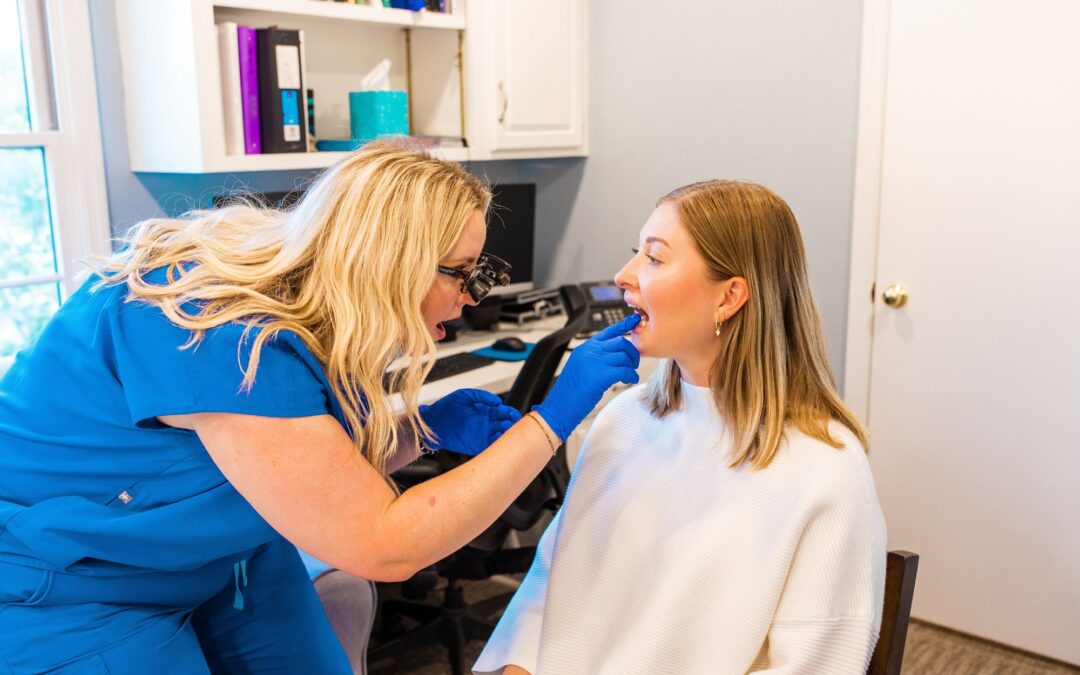
Most people think of dental care as something that happens once or twice a year: a cleaning, maybe a filling, and a reminder to floss more. But what if your mouth held the key to how well you breathe, how deeply you sleep, and how your entire body functions? What if the position of your tongue right now (yes, right now!) was either supporting your health or quietly working against it?
The connection between teeth alignment, tongue posture, and airway health is one of the most important and underappreciated relationships in whole-body wellness. And right now, people who understand this connection are getting better sleep, breathing more efficiently, and avoiding a cascade of health issues that others won’t even realize they have until years down the road.
Don’t be the person who finds out too late.
The tongue has a “correct” resting position. Does yours know it?
Most people have never thought about where their tongue rests when they’re not talking or eating. But tongue posture, where your tongue sits habitually in your mouth, plays a massive role in shaping the development and alignment of your teeth, jaw, and airway.
The ideal resting position has the tongue gently pressed against the roof of the mouth (the palate), with the tip just behind the upper front teeth. When this happens consistently, the tongue acts like a natural retainer, gently shaping a wide, well-developed palate that supports open airways and proper teeth alignment.
When tongue posture is poor: resting on the floor of the mouth, pushing against the teeth, or falling back toward the throat. The consequences compound over time:
- The palate may develop narrowly, crowding the teeth
- The lower jaw can be pushed backward, restricting the airway
- Mouth breathing often develops as a compensatory habit
- Sleep-disordered breathing and snoring become more likely
- Facial development in children can be significantly altered
Are you willing to let your wrong tongue posture silently reshape your jaw and airway?
How teeth alignment is about far more than aesthetics
Crooked teeth are often treated as a cosmetic concern, something to fix for the sake of a prettier smile. But misalignment tells a deeper story about what’s happening structurally inside your mouth and throat.
When teeth are crowded or the bite is off, it’s frequently a sign that the dental arches (the bony structures that hold your teeth) haven’t developed to their full potential. A narrow upper arch means a higher palate, which in turn means less space in the nasal cavity above it. Less nasal space often leads to restricted nasal breathing, forcing the body to compensate by breathing through the mouth.
This creates a cycle that’s hard to break without addressing root causes:
- Mouth breathing leads to lower tongue posture
- Lower tongue posture fails to expand the palate
- A narrow palate keeps the airway small
- A small airway makes deep, restful breathing harder
- Poor breathing affects sleep quality, energy levels, mood, and long-term health
The Famous Airway
Here’s what most traditional dental practices won’t spend much time discussing: your airway. The upper airway (the passage that runs from your nose and mouth down to your lungs) is directly influenced by the size and shape of your oral structures. And if yours is compromised, the effects ripple out in ways that are often misattributed to other causes.
Signs that your airway health may be affected by oral structure issues include:
- Chronic snoring or sleep apnea
- Waking up tired despite a full night of sleep
- Frequent headaches, especially in the morning
- Mouth breathing during the day or night
Teeth grinding or jaw tension - Difficulty concentrating or low energy throughout the day
- Restless sleep in children, or bedwetting, behavioral issues, and difficulty focusing at school
Do these sound familiar?
This is exactly why airway-focused dental care is changing lives. Practitioners trained in functional dentistry and myofunctional therapy are trained to see beyond the teeth and into the full picture of how your oral structures affect your ability to breathe, sleep, and thrive.
The Magical Myofunctional Therapy
Myofunctional therapy is a specialized program of exercises and habit retraining that addresses the muscles of the tongue, lips, and face. It’s one of the most powerful tools available for correcting the root causes of poor tongue posture and airway restriction.
At Columbia Dental Group, our myofunctional therapist, Ali, works alongside Dr. Sarah Clayton to help patients of all ages retrain oral muscles, correct tongue posture, and support proper breathing patterns. The results can be remarkable: improved sleep, reduced teeth grinding, better nasal breathing, and even positive changes in facial structure. The best part? All of this is completed without surgery!
For patients with tongue or lip ties, which are restrictions in the tissue connecting the tongue or lip to the floor or roof of the mouth, we also offer CO2 laser frenectomy and functional frenuloplasty.
Don’t wait until the problem gets louder

The practices that understand this connection are helping patients resolve issues that have gone unaddressed for years: fatigue, grinding, poor sleep, restricted airways, and misalignment that keeps coming back because the root cause was never treated.
At Columbia Dental Group, our team takes a whole-health approach to every patient. We use advanced tools like iTero scanning and CO2 laser technology. Whether you’re curious about myofunctional therapy, concerned about your child’s development, or simply want to understand how your mouth is affecting the rest of your body, we’re here to help you connect the dots.
Book your appointment online or call us at (931) 381-7591 to schedule a consultation with Columbia Dental Group today.